
Disclaimer: Church paperwork assistance is available exclusively to full-service planning clients.
Getting married in a Catholic church in Italy is entirely possible, and the requirements haven’t changed significantly in 2026. But here’s what most couples don’t realize: the documentation process varies significantly between dioceses, parishes, and even individual priests.
Some churches in Tuscany require different paperwork than those in Rome or Amalfi. And most Italian priests don’t speak English fluently (many don’t speak it at all), which adds serious complexity to coordinating documents between your home parish and the Italian church.
This guide outlines the general Catholic wedding requirements for Italy, but the real challenge isn’t collecting the paperwork. It’s navigating regional differences, managing translation between parishes, and staying on top of deadlines that nobody will remind you about.
Having someone local who speaks both languages and understands Italian church bureaucracy can save you months of frustration and missed deadlines.
First of all, to get an actual religious marriage in Italy valid in your country as well, at least one of you must be a Catholic. Different churches have different requirements though.
If the other spouse is not Catholic, you should get a document called “Permission of mixed religion” to testify that the wedding celebration can be performed by the Italian church. The Non-Catholic spouse will need their Baptism certificate to get it.

Your options for the marriage in a church in Italy
1. You can have the Concordat wedding – you get married by a Catholic priest and the State recognizes its civil effects. It requires more paperwork since the marriage must be transcribed in your own country. For this ceremony you have to follow all the steps of the civil ceremony, except it will take place in a church and not in the town hall.
2. You can have the Catholic ceremony in Italy and the civil one in your home country. This makes bureaucracy easier but you still need to collect some paperwork.
3. A private ceremony in a chapel at your location if there is one. In this case, if the Chapel is consecrated, one of you must be a Catholic and you must have an actual priest to officiate your wedding – hence, get all the paperwork done. If the Chapel has been desecrated, you can get your own officiant but it won’t be an actual priest since they can officiate marriages in consecrated places only.
Getting married in Italy with your own priest
What if you want to get married by the priest who knows your family well and you want a destination wedding in Tuscany at the same time? It can be arranged.
Some Italian priests might not speak the language of the spouses. In this case, you have two options:
1. Officiate the ceremony in Italian with a translator, which I don’t suggest because you will lose that special romantic atmosphere plus the ceremony will be longer;
2. The spouses (not the Italian church) have to find a different priest from the resident one who does speak the language of their country. It may take some time and it is not always easy.
So, if you bring your own priest with you, it makes things easier for their Italian counterpart. The resident priest must authorize the ceremony.
The rules of a Catholic marriage ceremony in Italy
As mentioned above, if you want to get married in a consecrated Chapel or a church in Italy, you must prepare all the paperwork.
Some churches have very strict rules. The ones that contain some precious art pieces might not authorize photos with flash, others may accept only some kind of decorations. Always ask your wedding planner to check these rules in advance.
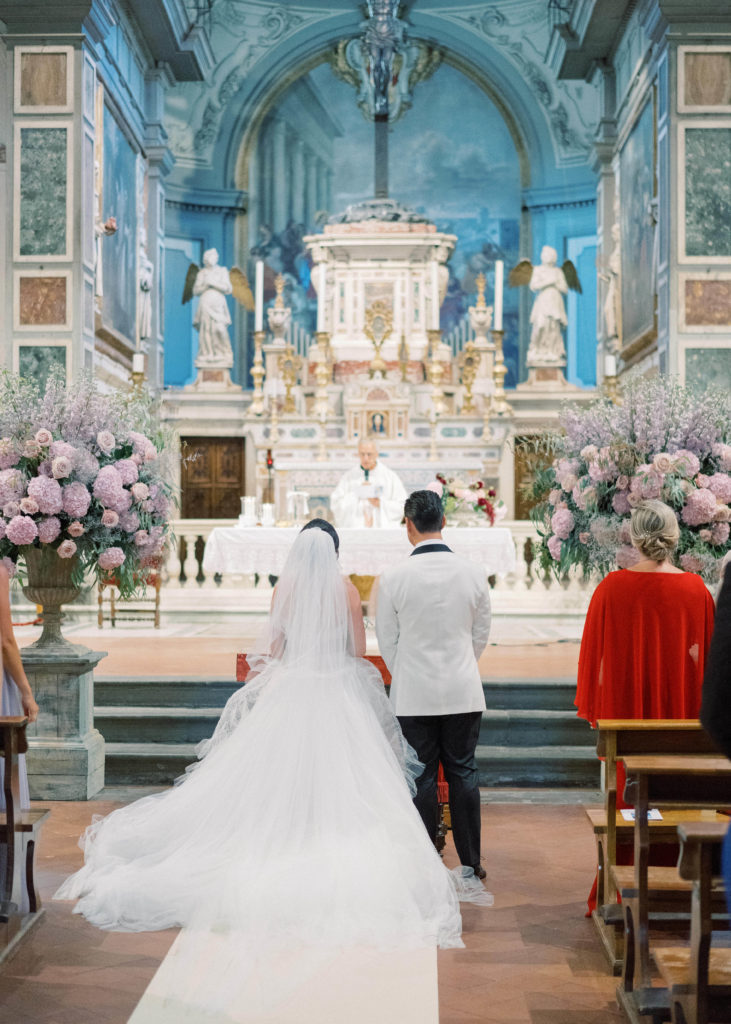
Documents for the religious ceremony in Italy:
Here is the paperwork you will need step-by-step. It may take some time to get them, so I recommend that you start collecting these documents from 6 to 4 months before the wedding.
Remember that most of them are valid for 3 months only. The only exceptions are the certificate of baptism, holy communion, and confirmation.
Of course, your wedding date in the church should be booked earlier, usually a year before, or even more in advance for some very popular churches.
Step 1: Contact your local Priest
You should contact your Priest and tell him you want to get married in Italy. In order for him to approve it, you will need the following documents:
a) Certificate of Baptism
b) First Communion
c) Confirmation
If you don’t have them and your local Parish can’t give you the originals, ask for some copies. They should be sealed by your local Bishop.
Step 2: Follow the Pre-Cana Classes
Your Priest will refer you to some pre-marital classes you need to take. After you have the certificate, you can ask for the next document.
Step 3: Ask your Priest to write a Formal Letter and the Prenuptial Enquiry form
d) Declaration or formal letter by your Priest or Pastoral Advisor
Italian Curia (Archdiocese) requires it to testify that your local Priest knows you and allows your wedding in Italy. In this document, he has to confirm that both bride and the groom are active in the Catholic Church and that they wish to have a religious blessing in Italy.
It has to be written in the letterhead paper of your Parish. Specify the name of the church you selected in Italy and your wedding date.
The letter also must state that you have fulfilled all the Pre-Cana Classes – attach the certificate you received.
e) Original Prenuptial Enquiry Form
The Prenuptial Enquiry Form is a prenuptial questionnaire, an investigation that includes your personal details and some general religious data.
It has to be filled together with your Priest when you are present. He writes it on a formal letterhead, then it has to be signed and stamped with the Church seals by your local Bishop’s office (not by your Priest) – see step 5.
Step 4: Obtain the “No Impediments” document from the Bishop of your Parish
f) Nihil Obstat
This is one of the most important documents required by the Italian religious Authorities – the letter from the Bishop of your Parish written on the letterhead of your Bishop’s office.
It certifies that the religious authorities over your local priest approve your religious wedding in Italy.
This letter must specify that you have “No Impediments” (that’s what “nihil obstat” means in Latin) to get married in the Italian Church you selected. It has to include the Church name and the date of your religious ceremony.
Step 5: Get the Prenuptial Enquiry Form and all other documents sealed by your local bishop’s office
Remember the Prenuptial Enquiry form at point e)?
After you fill it together with your Priest, it has to be signed and stamped with the Church seals by your local Bishop’s office (not by your Priest).
This document is issued by the Archdiocese of your city. The Italian Curia (Archdiocese) requires it as proof that your wedding has been approved by the highest member of the Catholic Church in your country.
Step 6: Check that all the papers are sealed and have the letterhead of your Archdiocese.
This is a very important requirement, make sure it is met to avoid having to do all the documentation twice.
Step 7: Send the documents directly to the Italian Priest of the church where you want to get married
A practice I recommend is to send scanned copies of the documents to your wedding planner before mailing them to Italy, so she can check with the local priest if everything is fine. Only after that, you can send all the original documentation.
Italian authorities must receive them from 6 to 2 months before the date of the wedding. To make sure this happens use DHL or FedEx to send the original documents. Always save the tracking number. Never use the regular postal service without the tracking number, it will take longer and your documents might get lost.
After approximately 2 months the Italian Archdiocese will give you their response and you will be able to marry in church in Italy!
If the documentation is right, the answer will be positive and you will be able to have the majestic and spiritual atmosphere of a beautiful Italian church during your wedding ceremony.
Need help with Catholic wedding requirements in Italy? This is part of my full-service planning process.
Don’t miss a thing! Follow me on Google
